Why healing feels impossible even when your life has changed


There is a particular kind of exhaustion that no one talks about enough.
It is not the exhaustion of someone still inside the storm. It is the exhaustion of someone who has survived it, left it, rebuilt around it — and whose body still has not received the message that the war is over.
You are not in danger anymore. You know this. You can list the evidence. The relationship ended. The job changed. The situation resolved. You are, by every external measure, safe.
And yet your shoulders live somewhere near your ears. Your jaw is set like a clamp. You do not breathe — not fully, not the way the body was designed to breathe — and you have been so braced for so long that you stopped noticing the bracing itself. It became the baseline. It became you.
This is not a character flaw. It is not weakness. It is not evidence that something is irreparably broken.
It is your nervous system doing exactly what it was designed to do — and not yet knowing it is allowed to stop.
The Body That Kept Counting
I know this particular terrain from the inside.
For years I carried a pain in my shoulder that I could not explain and could not heal. I tried everything the body-mind world had to offer. Nothing touched it. Nothing lasted. It was not until I began doing the deeper work — not on the shoulder, but on what the shoulder had been holding — that I understood what was actually happening.
My body had been braced. Constantly. Architecturally. Not as a response to any single moment but as a structural adaptation to years of environments that required vigilance, readiness, and the perpetual management of invisible threat.
I did not know I was doing it. That is the thing no one tells you clearly enough: the brace becomes invisible because it becomes normal. It stops feeling like tension and starts feeling like just how you are.
It was the same with my breath. I did not know I was not breathing — not properly, not all the way down — until I became aware of the absence. Until I noticed the half-breath that passed for enough. Until I felt, for the first time, what it was like to exhale completely and realised I had not done that in years.
The clenched teeth. The held belly. The locked glutes. I was not doing these things consciously. My body was doing them for me, faithfully, because somewhere in the nervous system’s ancient intelligence, letting go felt like becoming unprotected. And unprotected had not been safe for a very long time.
"Staying braced stopped feeling like tension years ago. It started feeling like personality. Like the shape of me. The unbrace didn't begin when I left the danger — it began when I finally noticed I was still holding it."
Vuyiswa Kayembe
What the Nervous System Actually Is
The nervous system is not a passive relay system. It is a living, adaptive, intelligent archive.
Every experience you have ever had — every moment of threat, every moment of unpredictability, every time you had to make yourself smaller or harder or less visible to survive — has been registered, catalogued, and factored into the nervous system’s ongoing threat assessment of the present moment.
This is not a metaphor. This is biology.
The polyvagal theory, developed by neuroscientist Stephen Porges, maps three states that the autonomic nervous system moves between: the ventral vagal state, where we feel safe, connected, and regulated; the sympathetic state, where we mobilise for fight or flight; and the dorsal vagal state, where we shut down, freeze, or dissociate. When a nervous system has spent significant time in sympathetic activation — in the chronic low-level fight-or-flight of a threatening environment — it begins to treat that activation as its home frequency.
Safety, paradoxically, can feel more threatening than danger. Because danger is familiar. Because the body knows how to perform under threat. It has years of practice.
What it does not have practice in — what it has often never been allowed to experience — is genuine, sustained, unguarded rest.
This is why people who have survived abuse, complex trauma, high-control relationships, or years of chronic stress often describe the same phenomenon: they got out, they did the therapy, they changed their life — and their body still behaves as though the threat is ongoing. Still startles easily. Still cannot sleep deeply. Still holds.
The brain’s threat-detection system, rooted in the amygdala, does not update simply because the circumstances have changed. It updates through somatic experience — through the body being guided, slowly and consistently, into the physiological experience of safety. Not told that it is safe. Shown. Repeatedly. Over time.
The African Understanding — The Body as Ancestral Field
Western neuroscience gives us a language for what happens in the individual body. It is useful. It is accurate in its way.
But it does not go far enough.
In African indigenous understanding, the body is not only a personal nervous system. It is an ancestral field. The tension you carry in your shoulder is not only your tension. It may be the unresolved vigilance of a lineage that has been navigating threat for generations — the adaptive bracing of ancestors who had to remain perpetually alert to survive colonial violence, displacement, loss, and erasure.
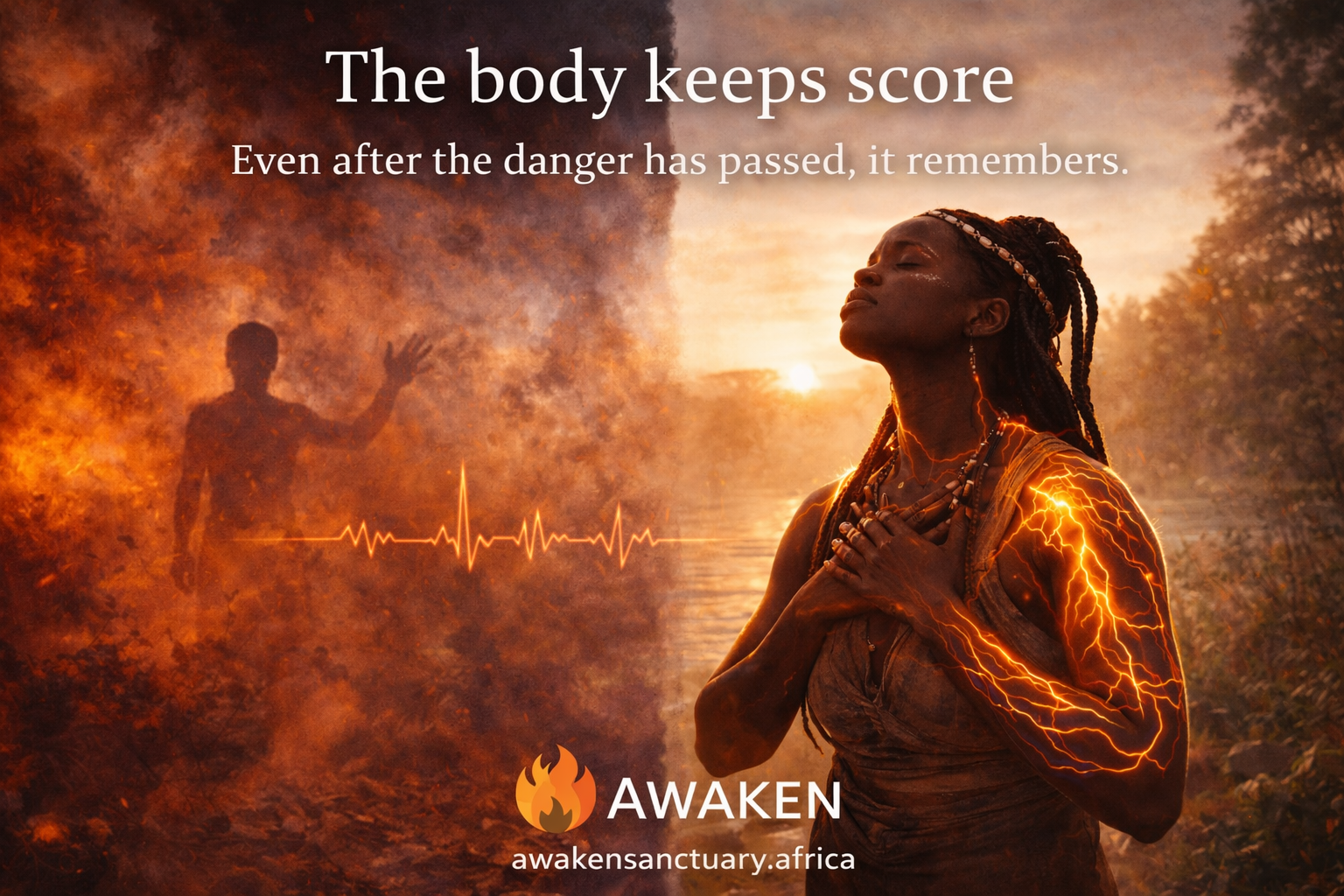
The body keeps the score, as the Western framework correctly identifies. But in the African ancestral framework, the body keeps multiple scores, across multiple generations, held in the cellular memory of the lineage.
This is what I mean when I speak of blood memory. When I work with a client whose nervous system will not release despite years of conventional healing work, I am not only looking at their personal history. I am listening to the ancestral field. I am asking: what has this lineage been braced against, and for how long?
This is the level at which the deepest unbrace becomes possible — not only regulating the individual nervous system, but witnessing and completing what the lineage has been carrying.
The Journey of Unbrace — What It Actually Requires
Learning to unbrace is not a technique. It is a journey. And it has distinct stages that I have moved through myself and now hold space for others to navigate.
The first stage is awareness.
You cannot release what you cannot feel. The first work is simply noticing — noticing the shoulder, the breath, the jaw, the belly. Noticing without immediately trying to fix. This stage alone can take time, because the brace has been invisible for so long that becoming aware of it can feel disorienting. Like suddenly being able to see the water you have been swimming in.
The second stage is permission.
The body will not release on command. It releases when it receives, at the somatic level, the message that release is safe. This is not a mental process. You cannot think your way into the unbrace. You have to create the physiological conditions — through breathwork, through specific body-based practices, through the felt experience of being held in a container that is genuinely safe — that allow the nervous system to downregulate out of sympathetic activation.
The third stage is detachment from the story.
This is where the deeper work begins. The brace is not only a physical pattern. It is an identity organiser. When you have been in survival for a long time, being braced becomes part of who you are. It becomes the vigilance that kept you safe. The hyperawareness that let you see danger coming. The tightness that meant you were not naive, not trusting too easily, not vulnerable in ways that had cost you before.
Releasing the brace requires, at some point, releasing the identity of the person who needed it. Not erasing that person — honouring what they survived — but no longer letting that survival-self run the present.
The fourth stage is the identity release.
This is the death-and-rebirth threshold. The person who was built to survive the danger has to be formally completed — not abandoned, not shamed, but thanked and released — so that the person who is built for what comes next can stabilise in the body.
This is the work that sacred plant medicine, in the framework of Sacred Blood Medicine, makes possible at the cellular and ancestral level. Not as a shortcut. As a blood memory activator — bringing the lineage’s accumulated brace into direct awareness so it can be witnessed, completed, and freed.
What Unbrace Actually Feels Like
No one prepares you for this part.
When the nervous system begins to genuinely release — not as a momentary exhale but as a sustained shift in baseline — it does not always feel like relief. Not at first.
Sometimes it feels like grief. Because the brace was not only protection. It was also connection to the people and the times that required it. Releasing it means acknowledging that those times are over. And that acknowledgement carries its own loss.
Sometimes it feels like vulnerability so acute it registers as danger. Because the nervous system does not yet know the difference between being open and being exposed.
Sometimes it feels like nothing — like a flatness, a quiet, that the hyperactivated system does not yet have the language to recognise as peace.
This is normal. This is the integration phase. And it is the phase that most healing modalities do not adequately prepare people for or support them through.
The unbrace is not the end. It is the threshold.
Reflection — A Few Questions to Sit With
Before you read on, take a moment. These are not questions to answer quickly.
Where in your body do you hold your vigilance? Can you locate it right now?
When did you last take a full breath — all the way down, all the way out?
If the brace could speak, what would it say it has been protecting you from?
What identity would you have to release if you were no longer the person who needed to stay ready?
What would it mean — practically, daily — to live in a body that believed the danger was over?
The Threshold Is Here. The Work Is Real.
You have already done so much. The reading, the therapy, the trying. You would not be here if you had not.
But information does not unbrace the nervous system. Experience does. Specifically — the experience of being held in a container precise enough to reach the level where the holding actually lives.
At Awaken Sanctuary for Awareness, the Nervous System Sovereignty intensive is a five-day async online journey that moves through the polyvagal framework through an African indigenous lens — mapping your specific activation patterns, introducing regulation as a spiritual practice, and beginning the rewiring that allows safety to become something your body actually believes rather than something your mind understands.
For those ready for the full container — the Soul Rejuvenation Retreat on sacred land in South Africa is eight days of immersive work: five days of online preparation, three days on the land, and sacred plant medicine at the centre. It is the most comprehensive nervous system, ancestral field, and identity release work I offer.
Both are by application only. Because precision matters. Because you have already spent enough time in spaces that were not built for someone like you.
If your body is still living in a war your life has already left — this is where that changes.
Begin your application at awakensanctuary.africa
Tags:ancestral healingAuADHD nervous systembody keeps the scorecomplex PTSD healinghealing trauma naturallynervous system after abusenervous system dysregulationnervous system healingnervous system regulationpolyvagal theorysacred plant medicine retreat South Africasomatic healing South Africatrauma and the bodyTrauma recovery

Vuyiswa Kayembe
Vuyiswa Kayembe is an initiated shaman, oracle, and African Death and Rebirth Doula — and the founder of Awaken Sanctuary for Awareness, a private psycho-spiritual healing sanctuary on sacred land in South Africa.
Her writing exists at the intersection of neuroscience, trauma psychology, nervous system regulation, and African indigenous healing wisdom. She writes for those whose experience of themselves exceeds what conventional frameworks can hold — the spiritually awake, the neurodivergent, the ancestrally called, and those standing at the kind of threshold that changes everything.
Every piece she writes is a transmission — grounded in the Sacred Blood Medicine framework, rooted in lived initiation, and written for the soul client who already senses that what they are looking for is not managed wellness, but sovereign transformation.